The Durand Cup: Before the World knew their NAMES
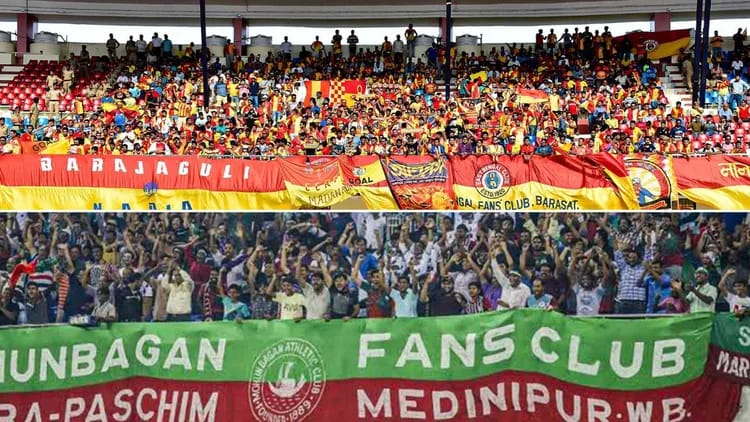
East Bengal, Mohun Bagan, and their Durand Legacy
The oldest rivalry opens the oldest Trophy: Kolkata derby to kickstart 135th IndianOil Durand Cup
The Durand Cup: Before the World knew their NAMES
Rooted in Kolkata, Reaching Five States: The Durand Cup’s Modern Expansion
Kolkata welcomes 135th IndianOil Durand Cup trophies as countdown begins to tournament kick-off
Jharkhand embraces 135th IndianOil Durand Cup as Trophy Tour marks Ranchi’s historic debut as host venue
Assam reaffirms commitment to football as 135th IndianOil Durand Cup Trophy Tour reaches Guwahati
Hon’ble Governor Shri Ajay Kumar Bhalla and Hon’ble Chief Minister Shri Yumnam Khemchand Singh Lead Imphal’s Celebration of 135th IndianOil Durand Cup Trophy Tour
The Durand Cup: 138 Years, One enduring story
Hon’ble Minister of Sports and Youth Affairs, Shri Wailadmiki Shylla Flags Off Shillong Leg of 135th IndianOil Durand Cup trophy tour
There is a photograph from the 1993 Durand Cup that Bengal football still passes around like folklore, a teenager, airborne, boot connecting with a ball he never should have reached. Bhaichung Bhutia’s bicycle kick against Border Security Force lasted about a second. The story of how he got onto that pitch took considerably longer.
East Bengal’s coach that year, Shyamal Ghosh, had a 16-year-old from Sikkim on his books who could already do things with a football that grown men couldn’t. He also had the sense not to say so out loud. Kolkata’s Maidan had a well-earned reputation for making prodigies and breaking them in the same season, and Ghosh wasn’t about to find out which one Bhutia would be by throwing him in too early. So the boy sat, watched, came on in fragments, and waited for a stage that matched what he had. The Durand Cup semi-final against Border Security Force gave him one, and his bicycle kick turned out to be the decisive goal, the strike that carried East Bengal into the final and, eventually, to the title. It remains the only Durand Cup Bhutia would ever win.
“A lot of talents have failed to take the pressure of the Kolkata Maidan,” Ghosh said years later, explaining the caution. It’s a fair summary of why the tournament mattered as much as the goal did, it was the first room big enough for Bhutia to be seen in, and the only time he’d get to lift the trophy himself.
One Mechanism, Two Stories
Nine years on, a much quieter version of the same story played out at the other end of the country. Sunil Chhetri’s Durand Cup with Delhi’s City Club in 2002 barely qualifies as a run, one goal in four games, out before the knockouts. Nobody was writing about City Club’s campaign afterward. But somebody was watching Chhetri, closely enough that the tournament named him one of its five Most Promising Players that year, and closely enough that Mohun Bagan came calling not long after. The captaincy, the caps, the records, all of it traces back to a tournament most people don’t remember he played in.
It would take two decades for the circle to close: on September 18, 2022, Chhetri finally got his hands on the one trophy that had eluded him, leading Bengaluru FC past Mumbai City FC by the odd goal in three in the final of the 131st edition at Kolkata’s Vivekananda Yuba Bharati Krirangan, his first Durand Cup title, won as captain of the club, twenty years after he’d first walked into the tournament as a name nobody was watching yet.
Different decades, different cities, same mechanism. The Durand Cup didn’t make either player. What it did was put them somewhere the right people were looking, at the exact moment they had something worth being looked at for.
The Underrated Function
That’s arguably the tournament’s most underrated function. Asia’s oldest football competition, 138 years old this year, tends to get discussed in terms of its finals, its clubs, its three trophies. Fair enough; that’s the history that photographs well. But running underneath the roll of honour is a quieter pattern: generation after generation, the Durand Cup has been where Indian football’s next names first got a proper look, well before anyone outside the game knew to ask about them.
The Gap Between Promising and Trusted
Timing has a lot to do with it. The tournament lands before the domestic season has settled into its habits, squads still being finalised, new signings still being bedded in, coaches still deciding whether the kid from the academy is actually ready or just looks ready in training. It’s a different kind of pressure than a friendly. Nobody remembers a friendly. A reserve full-back who gets ninety minutes here because the first-choice man is injured isn’t playing a trial, he’s playing a match that counts, against opposition that won’t be gentle about it. That gap between “promising in training” and “trusted in a real fixture” is exactly the gap the Durand Cup exists in.
New Names, Same Pattern
It’s also a gap that keeps refilling with new names. FC Goa’s 2021 win is remembered for the trophy, but it’s just as often remembered now for introducing Muhammed Nemil to a wider audience, a teenager who played like the occasion didn’t bother him at all. A year later it was Lallianzuala Chhangte’s turn, finishing as top scorer on his way to becoming one of the country’s most reliable forwards. Different players, different clubs, same tournament doing what it has quietly done since Bhutia’s era: handing someone a stage slightly before the rest of the football world thought to look.
A Bigger Stage
What’s changed is the size of that stage. The Durand Cup’s revival under the Indian Army’s Eastern Command in 2019 didn’t just bring the tournament back to Kolkata, it set off an expansion that has since carried the competition into Guwahati, Imphal and Shillong, cities where football isn’t a Sunday habit but closer to a civic identity. This year, Ranchi joins as a fifth host city, and the 135th edition becomes something closer to a travelling tournament than a fixed one.
That matters for the same reason the timing does. A wider footprint means more of these first-look moments happen in front of crowds who’ve been waiting generations for a national tournament to actually visit them, a schoolboy in Imphal watching an ISL side train on a pitch he recognises, a local coach picking up something from a session he’d otherwise only have read about, a smaller club discovering exactly how far off the pace it is by testing itself against one that isn’t. None of that shows up in a match report. All of it is how a football culture actually grows, not through academies alone, but through proximity: the sense that the top level of the game is reachable, because it just showed up in your city.
The Throughline
Which is really the throughline here. The Durand Cup isn’t in the business of manufacturing talent, nobody is; that’s still built the slow way, through years nobody sees. What it has reliably done, for longer than almost any other tournament in world football, is put talent in front of the people who decide what happens next. Bhutia had that moment in a semi-final in 1993. Chhetri had it in a tournament his own team didn’t survive. Nemil and Chhangte had it in more recent, more visible years, but the mechanism hasn’t changed at all.
Somewhere in this year’s draw, in one of five cities, that mechanism will run again. A name nobody outside a training ground has heard yet will get a start he didn’t expect, or ninety minutes he has to make count. He won’t know it’s happening. That’s usually how it works, the significance only becomes obvious in hindsight, the way it did for a wiry 16-year-old in 1993, and for an anonymous striker from Delhi nine years later. For now, he’s just a name on a team sheet. The Durand Cup has a long history of not leaving it that way.
