The fear was gone – That was the moment Birendra Thapa knew Shillong Lajong had changed

East Bengal win record-equalling 17th Durand Cup with thumping victory over Mohun Bagan
Midul Doley and the making of a Durand Cup story nobody saw coming
Eleven men & A Village fairy tale: Chesterpoul Lyngdoh and the rise of Nongkseh on the Durand Cup stage
The fear was gone – That was the moment Birendra Thapa knew Shillong Lajong had changed
Mohun Bagan prevail on penalties over defending champions NorthEast United to set up Kolkata Derby final
Lalrinliana Hnamte slipped into the Durand Cup quietly – Then made sure everyone noticed
East Bengal FC edge SC Delhi on penalties to reach 135th IndianOil Durand Cup final
A Stage to Shine: Emerging Talents finds their moment at the 135th IndianOil Durand Cup
A mother’s stick, A Captain’s armband: Kenstar Kharshong’s Durand Cup Odyssey
The long way home: Halicharan Narzary’s return to Bodoland

For more than two decades, Birendra Thapa has lived in almost every version of Shillong Lajong — player, manager, assistant coach and now head coach. Somewhere along the way, he stopped merely being part of the club’s story and began shaping what comes next.
There was a time when going away from Shillong meant something to Shillong Lajong.
It meant leaving behind the familiar ground, the familiar supporters, the familiar conditions. It meant stepping into an opponent’s stadium and, somewhere in the back of the mind, carrying the suspicion that perhaps Lajong were not quite the same team outside home.
Birendra Thapa remembers that feeling. He remembers it because removing it became one of the most important things he has done as a coach.
The game that changed it was against Gokulam Kerala. Four in the afternoon. Heat. An away ground. The sort of fixture in which, Thapa says, his players had historically carried the fear of losing before the game had properly begun.
So he told them something simple. “Go out, don’t get fear.”
They won. For Thapa, that afternoon was more significant than the result. “I think I took the fear from the boys of losing,” he says.
It is a line that perhaps explains his coaching philosophy better than any formation or tactical instruction could. Because Thapa’s journey in football has always been about crossing boundaries.
From a boy who followed his brothers to the football ground in Shillong to a player who helped Lajong reach the I-League. From a footballer forced into coaching by injuries and age to a coach who eventually left Shillong, worked elsewhere and returned. And now, with an Indian squad built heavily around young players, he is trying to convince another generation that they can compete anywhere.
“We are ready to take any challenges,” he says. “We can play with any team on any given condition. Maybe results will not, but we are not afraid of losing. We can give tough competition to any team.”
That last sentence is important.
Not we will win. Not we should win. We can compete.
For Thapa, that is where belief begins.
Football came before he did. There is an easy way to tell the story of Birendra Thapa.
He joined Shillong Lajong in 2001. He played until around 2009-10. He became part of the team that took the club into the I-League. He moved into coaching. He left Shillong. He returned. Now he is leading Lajong from the touchline.
But that version misses the most important part. Football was already waiting for him when he arrived.
“Actually, football is in my blood. It’s in our family gene,” Thapa says.
His father played. His elder brother played. His relatives played. His father’s elder brother, Puran Bahadur Thapa, played for India and, according to Birendra, scored a hat-trick against Pakistan in a Quadrangular Cup.
The youngest Thapa did not need much persuasion. At three or four years old, he was already following his brothers to the ground. There was not much football on television in those days. Instead, there were conversations at home. Football was discussed, dissected and remembered.
“I used to hardly see, but I can hear they are talking and all about getting football and all,” he recalls.
That was enough. He grew up in Shillong, played in the city’s Under-16 competition, represented Meghalaya at different age-group levels and eventually played for clubs including Lama Villa, Waindu and Langsning. Then came Lajong.
Not as a grand destination. At first, it was almost a logical gathering of friends. Most of the players from the successful group he had been part of were already there.
“Mr Ming called me, then why don’t you come and play in Shillong Lajong? Because most of your friends are playing in Shillong Lajong,” Thapa remembers.
He came. He stayed. And slowly, the club became inseparable from his identity.
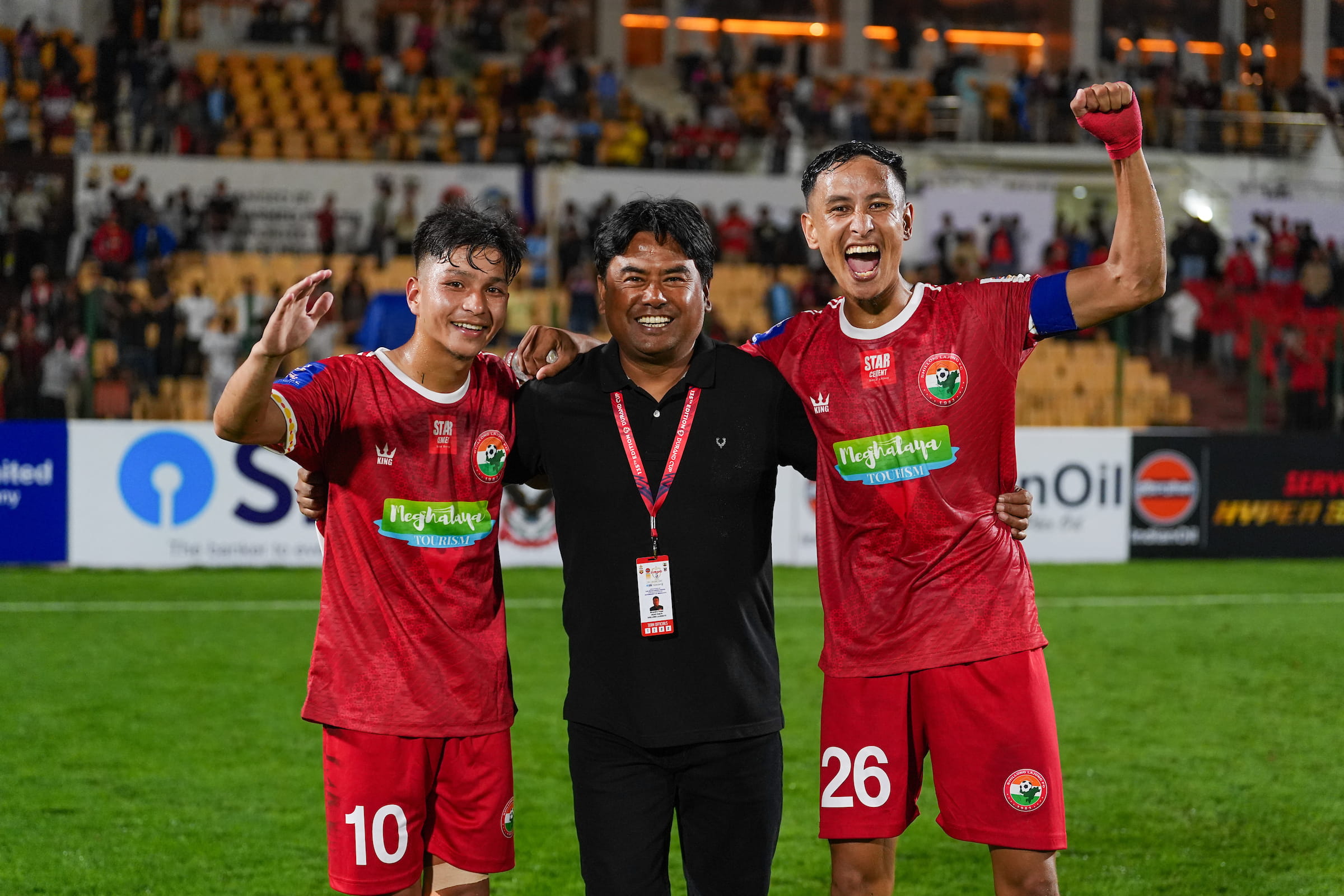
The year Lajong changed the map
Thapa’s playing career at Lajong coincided with the club’s transformation. There was a time when Northeast football could dominate within the region and still struggle to make an impression nationally. Shillong teams would win the Northeast rounds, qualify for the final stages and then find themselves up against sides with greater resources and considerably more exposure. Lajong kept returning.
Eventually, the club’s management began to believe that what the players were doing deserved greater investment. Foreign players were brought in. The squad was strengthened. Then came Gurgaon. Lajong finished second and qualified for the I-League. Thapa was there.
“It was a huge, huge moment for the Northeast,” he says.
The significance of that qualification is difficult to separate from what happened afterwards.
Players from the region suddenly had a club playing at the national level. Shillong was no longer merely producing footballers who had to leave home to be noticed. There was a platform at home.
“After Lajong qualified, it opened the door for all of the Northeast,” Thapa says.
That sentence carries particular weight coming from someone who had experienced the limitations himself. There had always been talent. What was missing was exposure. Lajong helped change that. And perhaps that is why, years later, Thapa remains so protective of the club’s identity.
“Shillong Lajong means, Lajong means our own,” he says. “It’s our own and Shillong Lajong has given me so much, first as a player, now as a coach. It’s my own family, it’s my heart. Nobody can take that out from me.”
The player had to leave before the coach could emerge His transition into coaching was not planned in some elaborate career roadmap. His body made the decision for him. Injuries were accumulating. Age was catching up. When Lajong reached the I-League, Thapa could not contribute as much on the field as he wanted. The club offered him another role. Initially, there was no neat distinction between responsibilities. He was the team manager. He was an assistant coach. He helped wherever he was needed.
“The staff was very less,” he says. “So I used to work as a team manager, as an assistant coach, everything.”
It was coaching by immersion. Eventually, he spent years with Lajong before leaving Shillong. There was Mohammedan Sporting, where he stayed only briefly, and then Srinidhi Deccan, where he spent three years working with different coaches. But distance has a way of changing how you see home. After several years away, Thapa returned. And when he did, Lajong was asking him to take another risk. No foreign players. An Indian squad. Young players. A club whose expectations had been built over years.
The message from management was blunt: take the chance.
Thapa did. “Challenges makes you better,” he says. “There are more challenges.”
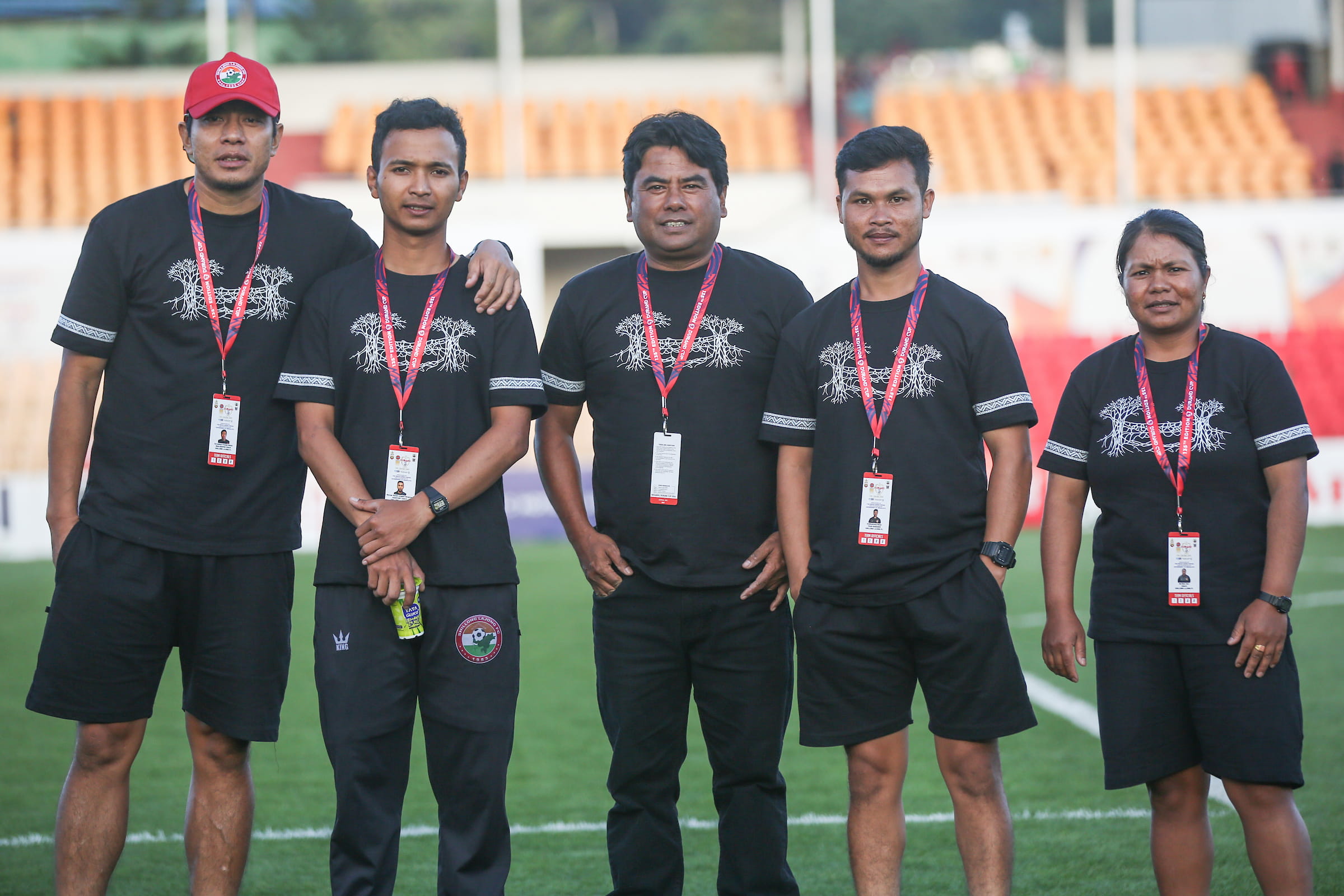
The fear of losing
Perhaps the easiest thing for a coach to do is talk about confidence. The harder task is to create it. For Thapa, confidence did not mean telling his players that they would beat everyone. It meant removing the idea that certain opponents, certain stadiums or certain conditions made them inferior before the match began.
That was why Gokulam mattered.
After that victory, Lajong lost elsewhere. They were beaten 3-0 by Dempo. But the defeat did not restore the old fear. They travelled again. They competed again. They won again. The cycle continued.
For Thapa, that was the real breakthrough. “After that, there was no stopping us,” he says.
The results mattered, but the mentality mattered more. That mentality has carried into his current Lajong side, a team that has increasingly become associated with young players and an all-Indian identity. For Thapa, that is not a compromise. It is the continuation of what Lajong has always represented.
“You can see there are so many players from Shillong Lajong who have played, now they are playing in the top leagues,” he says.
He lists player after player who began their journey at the club. The names change. The pathway remains. Two Durand Cups, two versions of the same man There is another reason the Durand Cup means something different to Thapa. He has experienced it from both sides of the technical area. He played in the tournament in 2000, when it was held at Ambedkar Stadium in Delhi. More than two decades later, he coached Lajong in it.
“Durand Cup is the first tournament for me as a coach,” he says.
Last year, Lajong’s run took them to the semi-finals, where they eventually lost to the eventual champions. For a coach working with an all-Indian squad, it was validation. For the man who had once played in the same competition, it was something more personal.
“It was a great experience and for me, it’s a good achievement also in my career.”
He has watched the tournament change, too. The facilities are better. Resources are greater. Players are exposed to more football. But the competition has retained something that Thapa values: opportunity. And opportunity is the word that keeps appearing throughout his story. His generation needed it.
Lajong needed it.
The Northeast needed it.
And the young players coming through the club need it now.
The standards never disappear. Ask Thapa about the players he admires and the answer is revealing. Cristiano Ronaldo, Sunil Chhetri. Not simply because of what they achieved with the ball. Because they kept working after they had already achieved enough to stop.
“Not because of the way he plays,” Thapa says of Ronaldo. “The way he keeps himself.”
He is fascinated by the discipline.
At an age when Ronaldo could seemingly afford anything, he continues to train, maintain himself and demand more. Thapa sees the same quality in Chhetri.
“For me, Indian player, next to him is Sunil Chhetri,” he says.
For a coach working with young footballers, those examples become teaching tools. Talent can open the door. Discipline determines how long you stay inside. A son of Shillong, still building Shillong There is a photograph that could almost summarise Thapa’s football life. He is standing on the touchline at the Jawaharlal Nehru Stadium, looking across a ground where he once played. The stadium has changed. The tournament has changed. Indian football has changed. He has changed. But the connection has not.
“It’s my own family, it’s my heart,” he says of Lajong.
Perhaps that is why the next part of his story feels less like a new chapter and more like a continuation. He was once one of the young players looking for an opportunity. Then he became part of a team that created an opportunity for an entire region. Later, he became the coach trying to convince young players that they were capable of taking the next step. And now, when he talks about the future, he does not sound like someone trying to preserve the past. He wants the players to go further than his generation did. He wants them to travel without fear. He wants them to compete against anyone. He wants them to believe that Shillong can produce players good enough for the highest levels of Indian football — because he has already seen it happen.
Football came into Birendra Thapa’s life before he was old enough to understand what it might become. It was family first. Then it became a profession. Then a responsibility. And somewhere between the playing days and the coaching days, between the first Lajong team and the latest generation, he became something else too: a custodian of Shillong’s football story.
The boy who once followed his brothers to the ground is now the man standing on the touchline, telling another generation not to be afraid.
And that, perhaps, is the most important part of Birendra Thapa’s story.
He is no longer simply trying to win football matches.
He is trying to make sure the players who come after him believe they belong in them.
