Midul Doley and the making of a Durand Cup story nobody saw coming

East Bengal win record-equalling 17th Durand Cup with thumping victory over Mohun Bagan
Midul Doley and the making of a Durand Cup story nobody saw coming
Eleven men & A Village fairy tale: Chesterpoul Lyngdoh and the rise of Nongkseh on the Durand Cup stage
The fear was gone – That was the moment Birendra Thapa knew Shillong Lajong had changed
Mohun Bagan prevail on penalties over defending champions NorthEast United to set up Kolkata Derby final
Lalrinliana Hnamte slipped into the Durand Cup quietly – Then made sure everyone noticed
East Bengal FC edge SC Delhi on penalties to reach 135th IndianOil Durand Cup final
A Stage to Shine: Emerging Talents finds their moment at the 135th IndianOil Durand Cup
A mother’s stick, A Captain’s armband: Kenstar Kharshong’s Durand Cup Odyssey
The long way home: Halicharan Narzary’s return to Bodoland
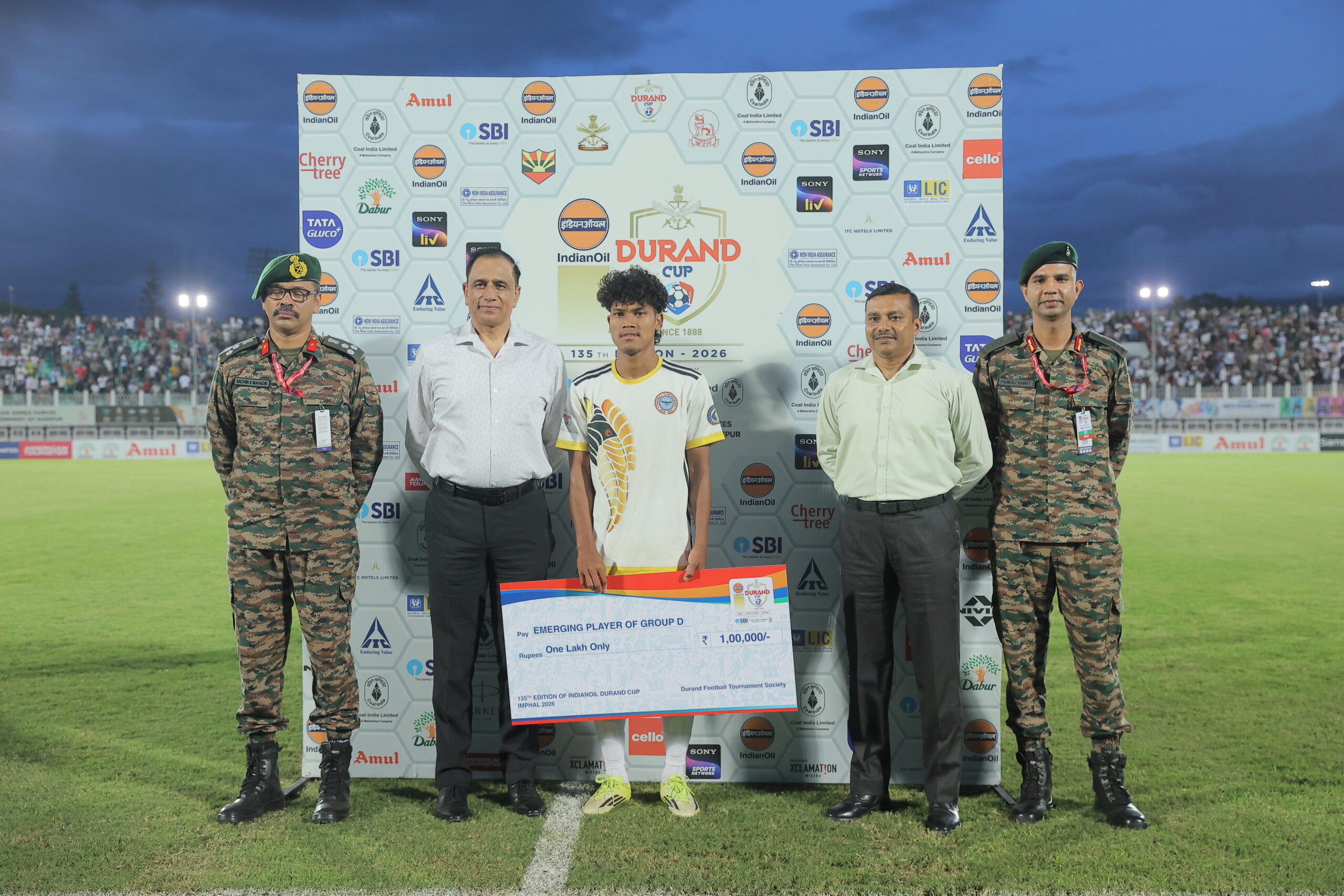
In the 79th minute at Khuman Lampak Stadium, TRAU FC’s crowd had already begun composing the story of their own comeback. A two-goal lead had dissolved into 3-3. FC Raengdai, a club not yet four years old, playing its first-ever Durand Cup, looked, for the first time all evening, like a team running out of answers.
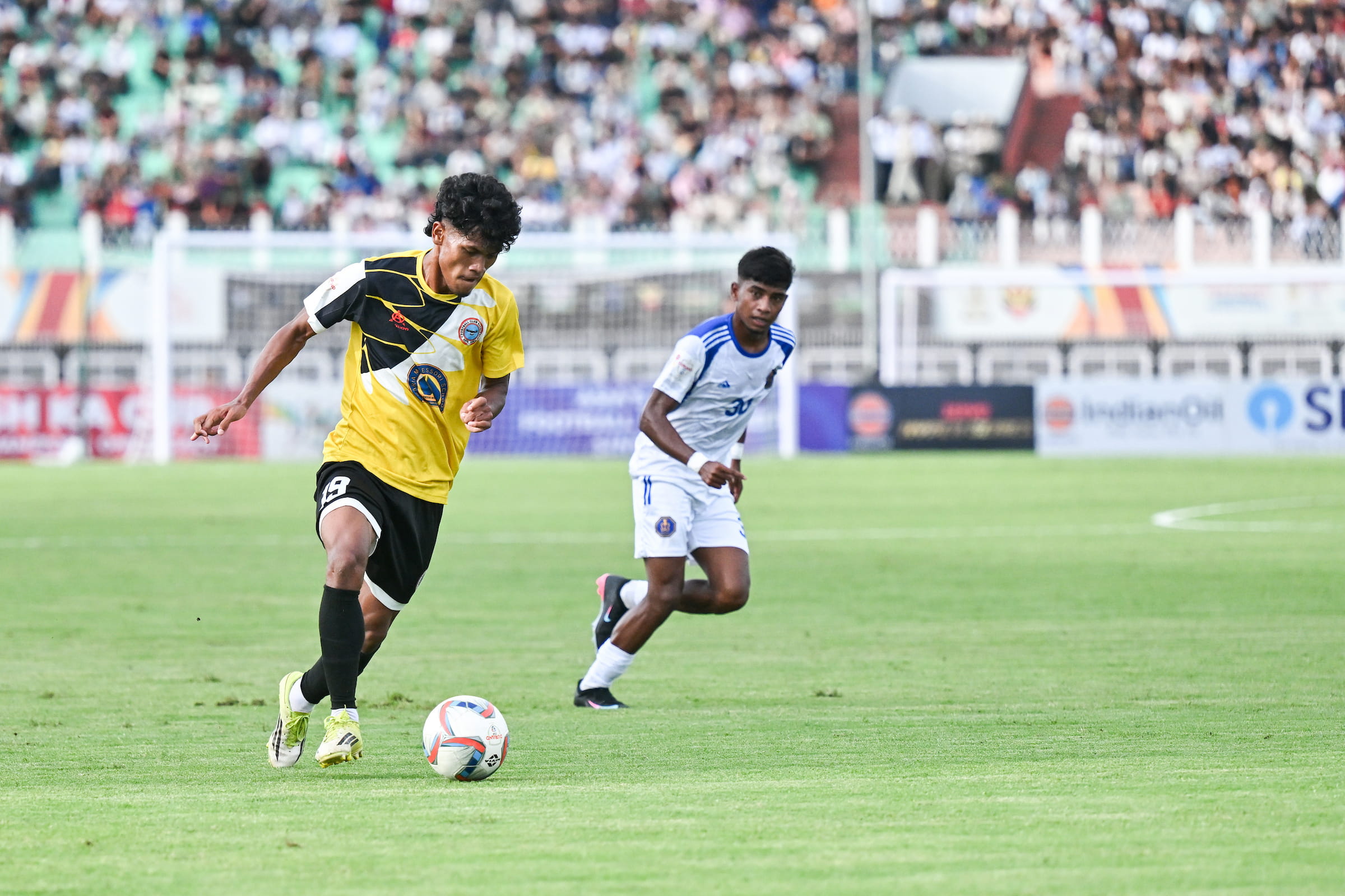
Then a corner curled in. Raengdai’s No.19 rose above two defenders who had no business losing him, and directed a header past the goalkeeper with the unhurried calm of a man closing a door behind him.
That header completed a hat-trick for Midul Doley. It also completed something quieter, a sentence he had been writing, one goal at a time, for two years, in places nobody outside Assam or Manipur was reading closely.
“There wasn’t much time to think on the pitch,” Doley says of the moment. “It was just instinct, reaction and then the celebration.” Asked to describe the biggest goal of his season, he gives the plainest possible account of it, which turns out to be the truest thing anyone could say about him.
A boy who belonged to no border
Long before Manipur, before FC Raengdai, before hat-tricks and headlines, there was Jonai, a town that sits on the Assam side of a line drawn through Arunachal Pradesh, a border that has always mattered more to cartographers than it did to a boy chasing a ball across whichever patch of ground happened to be free.
“Jonai is where I grew up, and football was just football for us,” Doley says. “We played with whoever was around us, irrespective of where they came from.”
It would be easy, writing about a footballer from India’s northeast, to reach for the border as a ready-made metaphor: two states, a divided boyhood, an identity in tension. Doley refuses that shortcut before it can even be offered. There was no fracture in his football. There was only the game, and whoever else happened to be standing on the same stretch of dirt.
What there was, even then, was instinct. “I always had that instinct to be around the goal,” he says, “but finishing is something I learned through playing and making mistakes.” He talks about repetition the way a craftsman talks about his tools, the same movements worn smooth over years, rehearsed ‘even when nobody was watching,’ until the geometry of a penalty box stopped being something he calculated and became something he simply felt.
Seventeen goals, and what they actually bought him
That instinct found its first real stage in 2025, when Doley finished the Assam Premier League as top scorer with seventeen goals, a season that ended, fittingly, with the title itself.
Even now, he resists dressing it up as inevitability. “I wouldn’t say I went into a game thinking, ‘I’m definitely going to score today,'” he says. “Football doesn’t work like that.” What he describes instead is smaller and more honest: good positions, a team that kept finding him, and a confidence that grew the way a snowball grows, not by design, but simply by continuing to roll.
Seventeen goals changed things at home, the way these numbers always do somewhere quieter than a stadium. “People started recognising me more, especially back home,” he says. But what he says next reveals where his compass actually points. “For my family, I think it was more about seeing that the hard work was actually taking me somewhere,” he explains. “They have supported me through the difficult periods as well, so being able to give them something to be proud of meant a lot to me.”
And then, almost as an aside that is really the whole point of him: “But at the same time, I knew I couldn’t stay there. The next level would always demand more.”

Where the margins get thinner
The next level was I-League 3, where the space shrinks and hesitation gets punished quickly. Doley finished top scorer there too, six goals, a smaller number than seventeen, but arguably the harder one to earn.
“The biggest change was probably the speed of the game,” he says. “You have less time, defenders are stronger and more organised, and mistakes get punished.” The adjustment wasn’t a new trick. It was patience, learning exactly when to run, and, just as important, when to wait. “I had to become more intelligent with my movement instead of just relying on physical ability.”
Asked for a signature goal, some repeatable pattern across two title-winning campaigns, he resists the tidy story the way he resists most of them. “I don’t know if there is one typical goal,” he says, “but most of my goals probably come from being in the right place at the right time.” He loves the sliver of space behind the last defensive line, the half-second before a defence resets itself. Sometimes it’s a first-time strike. Sometimes it’s simply reacting before anyone else in the box has finished thinking. “I think my biggest strength is that instinct inside the box,” he says, and by the fourth time he has said some version of this, it no longer sounds like a boast. It sounds like a fact he has simply learned to live with.
An outsider in someone else’s story
Then came Manipur, a leap that was as much about belonging as it was about football.
FC Raengdai is young and fiercely tied to its own region, the kind of identity that takes root fast in northeastern Indian football, where a club can feel less like an institution and more like an extension of a place itself. Doley arrived as an outsider, carrying two state borders behind him, and understood immediately that goals alone would not be enough to earn him a seat at that table.
“Every club has its own culture, and Raengdai has a very strong connection with its people and its home,” he says. “At first, you obviously notice the difference.” But the door opened and stayed open. “I’m grateful that the boys accepted me and made me feel part of the group. For me, representing the club is now about more than just being an individual player.”
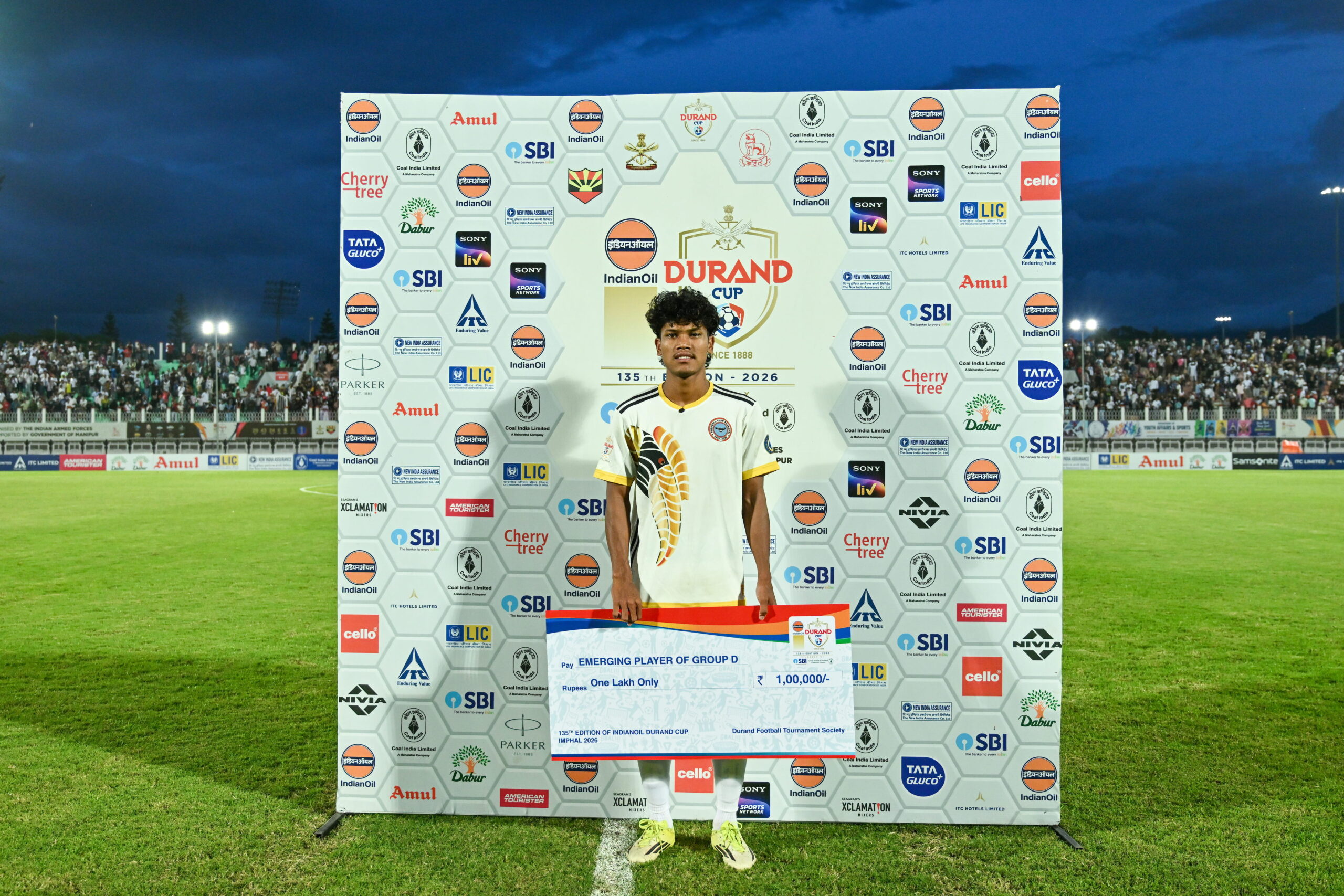
What followed became one of the genuine stories of this year’s Durand Cup. FC Raengdai, in their maiden appearance at Asia’s oldest football tournament, topped Group D and reached the quarter-finals, the only debutant club in the entire competition to manage it. Doley scored three goals and set up another across the group stage, work that earned him the Durand Football Tournament Society’s Emerging Player honour for Group D, one of just eleven such awards handed out across six groups this year, and the only one to come out of his group.
FC Raengdai’s run ended at the quarter-final stage, against SC Delhi. But some endings do not feel like conclusions so much as chapter breaks, a pause before something larger.
The hat-trick, and what came before the headline
There is a version of this story that stops at TRAU, because it is the obvious place to stop. Doley keeps quietly walking past it.
Asked about his partnership with teammate Khaidem Amarjit Singh — the two have assisted each other’s goals in consecutive matches this season, a kind of reciprocity that looks choreographed from the outside — he shrugs off the suggestion of design. “I think it developed naturally,” he says. “When you train and play together, you start understanding each other’s movement without having to say much.” Amarjit finds him before Amarjit quite knows he is looking. Doley returns the favour without remembering deciding to.
And when the hat-trick finally arrived, in a stadium far from Jonai, in the shirt of a club barely old enough to have a history of its own, his first thought was not of records. “My family was definitely one of the first things that came into my mind,” he says. “They have been there from the beginning, through all the difficult times and all the sacrifices. Knowing that they were able to follow the game and see me score those goals made it even more special.”
It is the closest Doley comes, in an hour of conversation, to sentiment, and even here he lands closer to gratitude than nostalgia. “When you are far away from home,” he says, “those moments make you realise who has supported you throughout the journey.”
What holds two titles together
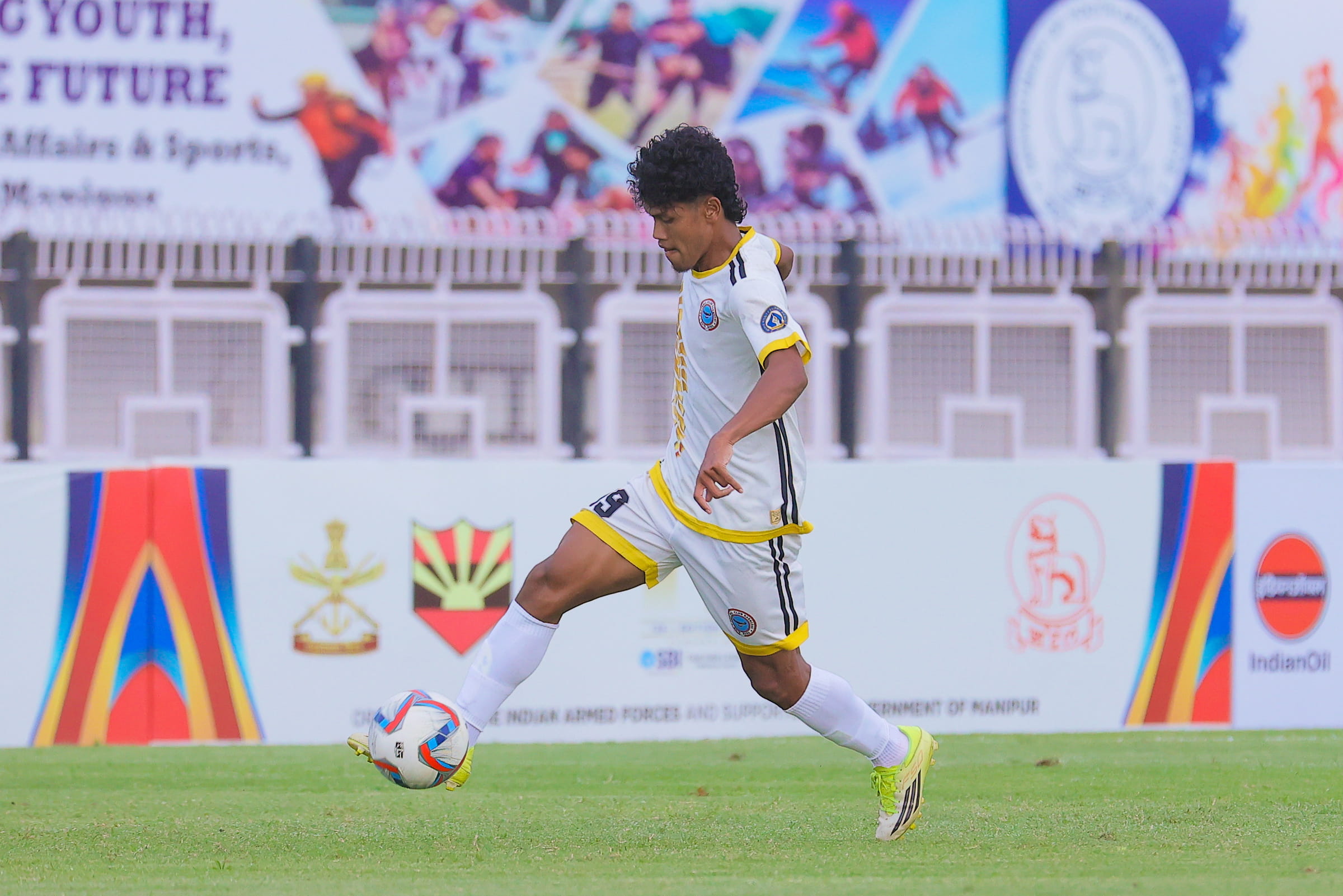
Asked what connects two top-scorer seasons across two different levels of Indian football, Doley does not reach for technique. “I would say mentality and consistency,” he says. “Technique is important, but you can have all the technique in the world and still struggle if you don’t have the right mindset.”
What follows sounds almost like a discipline, self-imposed and quietly maintained. “Every new season starts from zero,” he says. “I try to stay hungry, work on my weaknesses and keep believing that I can score against whoever is in front of me.” No coasting on old numbers. No credit carried forward. Just the next match, approached as though the seventeen goals and the six goals belonged to someone else entirely.

What comes after zero
The boy from the Assam-Arunachal border now faces a quarter-final exit still fresh, and a young club that has already outgrown its own expectations in a single season.
Of FC Raengdai, Doley allows himself real hope without romanticising it. “To reach the quarter-finals of the Durand Cup at this stage of the club’s development shows what is possible,” he says. “But we shouldn’t be satisfied with just reaching that stage. We have to learn from the experience and come back stronger.”
Of himself, he offers appetite rather than certainty. “I want to keep improving, keep scoring and keep testing myself at higher levels,” he says. “I don’t want to put a limit on where I can go.”
Asked what a third consecutive title-winning season would demand, his answer somehow wants everything and very little, all at once. “The same things that got me here, but at an even higher level,” he begins, before correcting course entirely. “But honestly, I’d rather win something with the team than just chase an individual scoring record.”
It is a small sentence, easy to miss. But it may be the truest one in the whole conversation, a striker whose every instinct points toward the goal, quietly saying that the goal was never really the point.
For now, there is only the next season, the next zero to start from, and a young man from a border few in Manipur had heard of eighteen months ago, still finding out exactly how far his own instincts can carry him.
