The Goddess’s XI: How Samaleswari Sporting found its way to Asia’s oldest football tournament
East Bengal win record-equalling 17th Durand Cup with thumping victory over Mohun Bagan
Midul Doley and the making of a Durand Cup story nobody saw coming
Eleven men & A Village fairy tale: Chesterpoul Lyngdoh and the rise of Nongkseh on the Durand Cup stage
The fear was gone – That was the moment Birendra Thapa knew Shillong Lajong had changed
Mohun Bagan prevail on penalties over defending champions NorthEast United to set up Kolkata Derby final
Lalrinliana Hnamte slipped into the Durand Cup quietly – Then made sure everyone noticed
East Bengal FC edge SC Delhi on penalties to reach 135th IndianOil Durand Cup final
A Stage to Shine: Emerging Talents finds their moment at the 135th IndianOil Durand Cup
A mother’s stick, A Captain’s armband: Kenstar Kharshong’s Durand Cup Odyssey
The long way home: Halicharan Narzary’s return to Bodoland
There is a stone in Sambalpur that has been worshipped since before anyone thought to write down why. It sits on the banks of the Mahanadi, carved into something that might be a face if you squint at it with enough faith, gold leaf pressed where the eyes should be, a nose ring of hammered gold hanging from a nose that was never quite sculpted. The people of western Odisha call her Samalei Maa. The kings who ruled here from the sixteenth century onward called her their Ista Devi, the deity of the family, the one who decides whether the harvest comes in or the river floods the fields instead. For four hundred years she has been the reason this town exists in any spiritual sense at all.
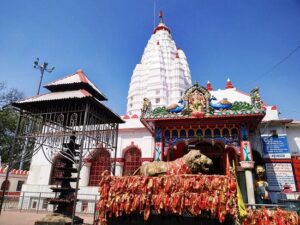
Now her name has been stitched across the chest of a football team that has taken its turn at Asia’s oldest football competition, having gone the distance against the Indian Army for ninety minutes under the Kolkata lights.
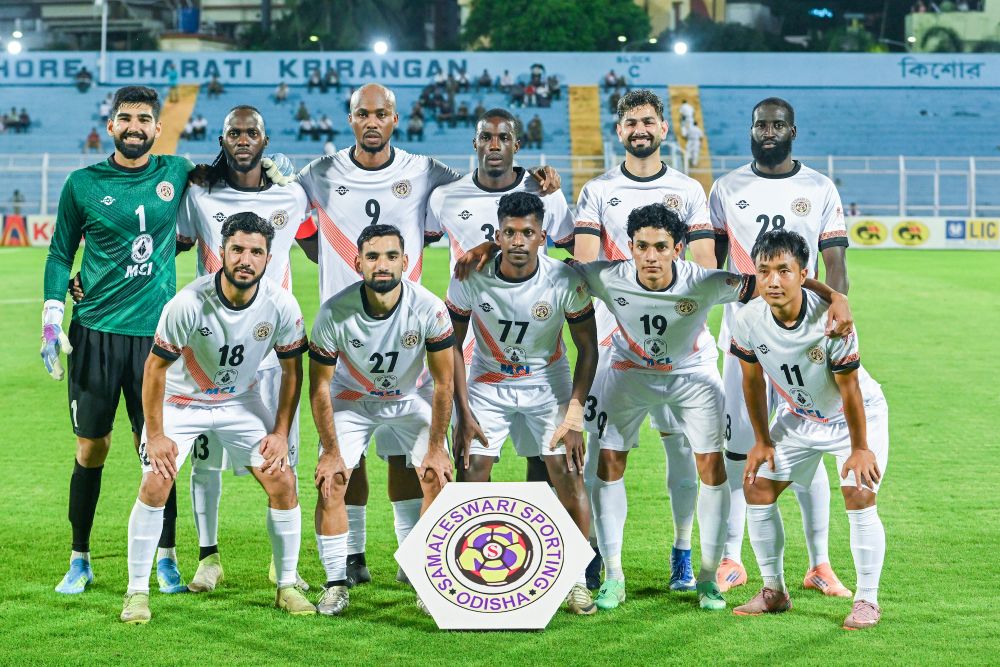
Samaleswari Sporting played their first match in the 135th IndianOil Durand Cup on the 26th of July, against the Indian Army Football Team, under lights at the Kishore Bharati Krirangan in Kolkata. The Army’s discipline and physical conditioning showed early, and Samaleswari found themselves defending for long periods against a side built differently to anything they had faced before. The only goal came from a moment of quality rather than a sustained siege, a second-half free-kick from P. Christopher Kamei, and goalkeeper Aaryan Anjaneya spent the rest of the night making sure it stayed at just the one. For a club assembled out of a coaching camp on the edge of a reservoir, in a small district town nobody outside Odisha’s football circuit could point to on a map, simply surviving that examination for ninety minutes was its own small victory.
From Pitapali to the Durand Cup
Every club has an origin story, but not many begin with a dam. Samaleswari Sporting was founded in March 2006 in Pitapali, a settlement roughly fifteen kilometres from Sambalpur town, in the shadow of the Hirakud Reservoir, held back by one of the longest earthen dams on the planet. It was not born out of a boardroom or a billionaire’s whim, but the kind of local ambition that usually fizzles into a Sunday league memory and, occasionally, does not.

Two years later, in November 2008, its academy was set up: the Sambalpur Football Academy, an initiative pushed through by the local MLA at the time, Jayanarayan Mishra, alongside Gouri Shankar Sahani and the late Rajendra Narayan Singh Deo, a former chief minister of Odisha. Mishra, who has represented the Sambalpur constituency across five terms and served as Leader of the Opposition in the Odisha Assembly, remains the club’s owner and the academy’s managing trustee today. This club was, in its origins, a piece of civic infrastructure as much as a sporting one, an attempt to give a footballing identity to a district otherwise known nationally as the place with the dam and the handloom sarees.

There were runs at the Churachand Singh Trophy, All India Football Federation knockout tournaments, and silverware in the Sambalpur Cup and the Biju Patnaik Memorial Trophy, mostly as runners-up, its own particular flavour of nearly. Then in January 2012, the club was certified by the AIFF to compete in the I-League 2nd Division, then the second tier of the pyramid, and found itself, for the first time, standing in a room with clubs that had actual histories. It did not go especially well. Fifth in Group A that first season was enough to end the campaign there, since only the group’s top two advanced to the round that mattered. The following year was worse on paper, one win, one draw, six defeats, second from bottom in a group that chewed them up, and again nowhere near the cut. After that, Samaleswari simply vanished from the national pyramid altogether, not relegated so much as quietly absent, resurfacing only a decade later in Odisha’s state league system before their name reappeared on a nomination list.
The Long Middle Distance
What happened between 2013 and now rarely made headlines, because nobody writes match reports about a club playing state league football in front of a few hundred people in Sambalpur on a Tuesday evening. But that is where clubs like this are actually built, in the accumulation of unremarkable seasons, in an academy that kept producing players even when there was no glory to show for it. It has, in its own modest way, mattered. Samaleswari now compete in the I-League 3, the fourth tier of Indian football’s reorganised pyramid, under head coach Abdul Azim Siddique, having arrived there on merit as champions of the 2025 Football Association of Odisha League, a state title that will not trouble many record books outside Sambalpur but was clearly enough to catch the eye of a tournament looking to widen its net. This year, Asia’s oldest football competition opened its doors to eight debutant clubs, among them Sporting Club Delhi, Baghpat FC, the Sri Lankan Armed Forces side Defenders FC, and, from the banks of the Mahanadi, Samaleswari Sporting.
One from Sambalpur
Rahul Oram did not feature in Samaleswari’s opening matchday squad against the Indian Army. A goalkeeper who only picked up football at fifteen, a late start by the standards of a sport that likes to claim its best stories begin in childhood, he spent the evening watching his teammates battle it out, present for the thing that mattered, even if the scoresheet will not remember him.
Afterwards, he did not talk about football tactics or missed chances. He talked about distance, and about a city that must have felt enormous compared to the one he grew up near.
“Belonging from a place like Sambalpur, coming here to a big city like Kolkata is like a dream come true,” he said. “It is a great feeling that I have a chance to play in the Durand Cup against some of the teams whose name I have heard for so long. I know East Bengal FC and Mohun Bagan Super Giant are big clubs here.”
There is something in that last line, the matter-of-fact way he places two of Indian football’s grandest institutions alongside his own club’s name, as though the gap between them is simply a fact of the tournament and not a verdict on where he belongs.
He spoke about home too, in the unguarded way that footballers who have not yet learned to be careful with reporters often do.
“I have my father, elder brother and sister-in-law back at home,” he said. “They are very happy that I have received this opportunity and they have given me my best wishes. I hope to make them proud.”
It is a small thing, a young goalkeeper naming the people who sent him off, but it is also the whole point of a club like Samaleswari existing at all.
A Debut with Company
Group B has handed Samaleswari an immediate education. They line up alongside the Indian Army Football Team, Mohammedan SC, one of Kolkata’s great old institutions with more history than most nations have football federations, and fellow newcomers Baghpat FC, freshly crowned I-League 3 champions and now promoted to the tier above. It is a group that will ask serious questions of a club whose entire senior footballing existence spans not even fifteen years. Two more matches remain before the group stage decides Samaleswari’s fate.
Why This Matters Beyond the Scoreline
It would be easy to read Samaleswari’s inclusion as a footnote to the group stage, a formality before the real business begins among the ISL heavyweights. That would miss what the Durand Cup, in its 135th year, is quietly doing by including them at all. This is a tournament that predates the Indian republic, older than most institutions people casually call ancient, and its continued relevance depends on more than nostalgia for Kolkata derbies. It depends on whether it can still function as a door that a club from Sambalpur can knock on and, eventually, walk through.
What happened on the pitch on that Sunday night in Kolkata will not go down as a famous result. Samaleswari lost 0-1 to the Indian Army, outplayed for large parts of the game by a side built on regimental discipline and physical conditioning, and kept in touch only by a defensive effort that refused to buckle until the very end. But Samaleswari Sporting have already done something that a great many bigger, richer, more storied clubs never manage: they have taken a football team assembled beside a dam in a small Odisha town and put it on the same team sheet, and the same pitch, as Mohammedan Sporting and the Indian Army, in a competition that has been running since the British Raj still had opinions about which regiments could field the best sides. There is still a tournament to play.
Head coach Abdul Azim Siddique, who led the team out for that first appearance, put the scale of it plainly afterwards. “It was a moment of pride and responsibility,” he said. “The Durand Cup is one of the oldest and most prestigious football tournaments in the world, so leading Samaleswari Sporting onto that stage for the first time was truly special for me. It was not just one match, it was about representing our club, our people, our players, our supporters, and the people of Odisha. It’s a milestone I will always remember.”
He was equally clear about what it meant beyond the ninety minutes. “It shows that a dream, chased through hard work, can become reality,” he said. “From a small academy near Sambalpur to competing in the Durand Cup, the journey reflects the passion and dedication of everyone connected to the club. We hope our story inspires young footballers across Odisha to believe that with commitment, they too can reach the highest level. This is only the beginning of Samaleswari Sporting’s journey. We are determined to keep growing and make our supporters, our club, and our investors proud.”
Somewhere on the banks of the Mahanadi, the goddess is still watching over the harvest. For ninety minutes in Kolkata, she had a football team to watch over too, and they gave her nothing to be ashamed of. What she has in store for the rest of the group stage is, as ever, entirely up to the eleven men who wear her name.
