Bend It Like Veer: Made in Sacramento, scored in Salt Lake

East Bengal win record-equalling 17th Durand Cup with thumping victory over Mohun Bagan
Midul Doley and the making of a Durand Cup story nobody saw coming
Eleven men & A Village fairy tale: Chesterpoul Lyngdoh and the rise of Nongkseh on the Durand Cup stage
The fear was gone – That was the moment Birendra Thapa knew Shillong Lajong had changed
Mohun Bagan prevail on penalties over defending champions NorthEast United to set up Kolkata Derby final
Lalrinliana Hnamte slipped into the Durand Cup quietly – Then made sure everyone noticed
East Bengal FC edge SC Delhi on penalties to reach 135th IndianOil Durand Cup final
A Stage to Shine: Emerging Talents finds their moment at the 135th IndianOil Durand Cup
A mother’s stick, A Captain’s armband: Kenstar Kharshong’s Durand Cup Odyssey
The long way home: Halicharan Narzary’s return to Bodoland
Nine minutes from time at Salt Lake Stadium, a nineteen-year-old with a Philadelphia birth certificate and a Kolkata heart bent a free-kick past Mohammedan Sporting and into the middle of a conversation Indian football has only just begun having. Veer Arjun Joshi talks family, free-kicks, and the parts of his identity that were never really in question.
Veer Arjun Joshi cannot tell you, with any real certainty, whose face he looked for when the ball hit the net.
He remembers striking it. He remembers knowing, in the small and private way footballers know these things, that the contact had been good, not the instant conviction some players describe, the sense that a shot is a goal before it has even finished travelling, but something quieter and more provisional than that. And then the net rippled, and by his own account, something in the evening simply stopped.
“I know it might sound dramatic, but that’s genuinely how it felt,” he says.
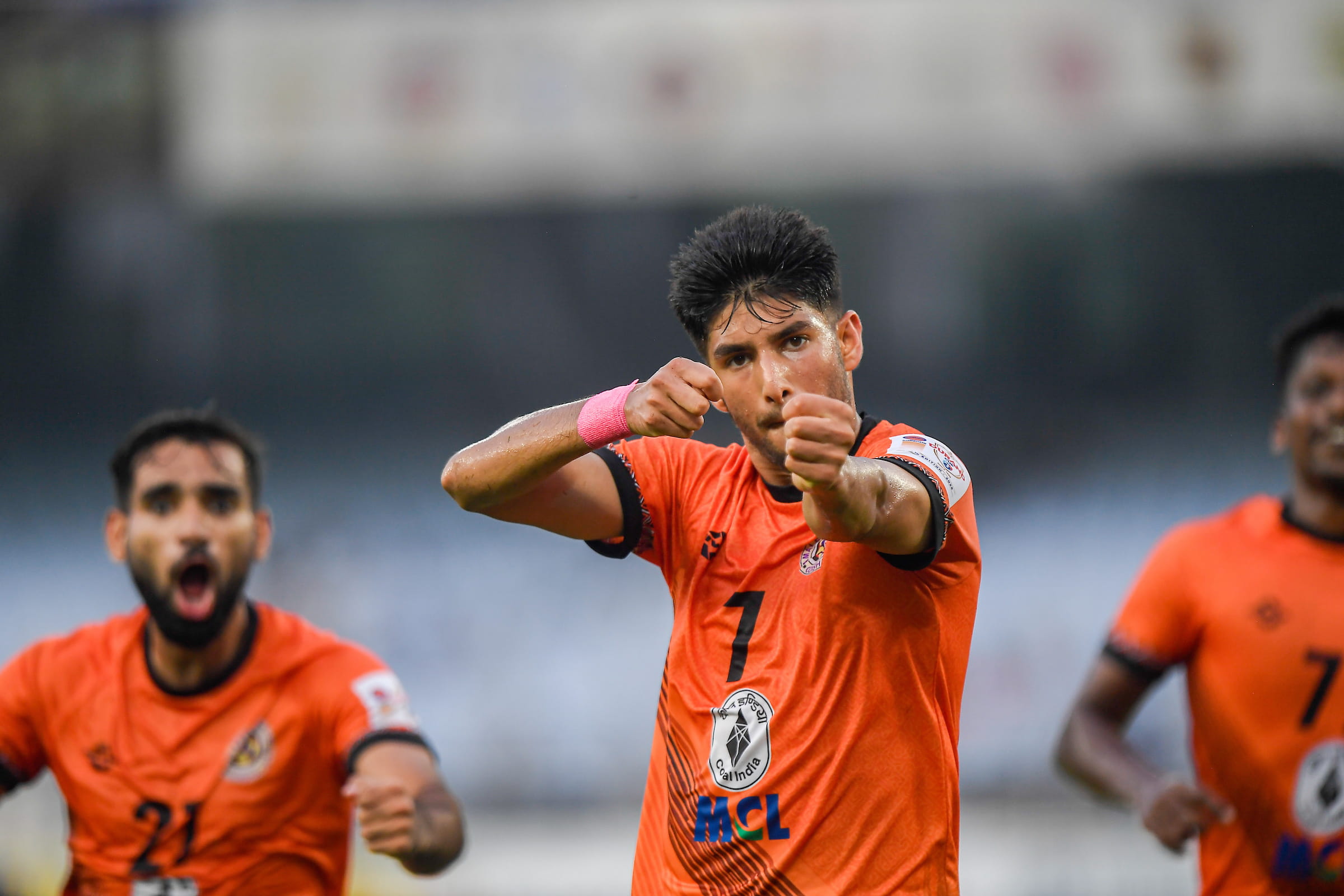
It was the 81st minute of Samaleswari Sporting’s Group B fixture against Mohammedan Sporting, at the Vivekananda Yuba Bharati Krirangan — Salt Lake Stadium, to virtually everyone who has ever stood inside its vast bowl — on Sunday, the 2nd of August. Samaleswari, debutants at this 135th edition of the Durand Cup and built up from a coaching academy in Sambalpur, Odisha, had led 2-0 before Mohammedan clawed level either side of the hour mark. Joshi, on as a substitute, stepped up to a free-kick just outside the box and curled it over the wall, beyond a goalkeeper with no real chance of reaching it. Final score: 3-2, one of the more startling results of this year’s group stage, against a club that had already become, in 1940, the first Indian side ever to win this tournament — seven years before the country itself gained independence.
Instinct took over first. He started running left, carried that way by pure momentum. Then he remembered something: a conversation, days earlier, with a cameraman named Emmanuel, who’d mentioned he would be positioned on the right-hand side of the pitch. He’d also noticed, during the warm-up, that most of Samaleswari’s small pocket of travelling support had gathered there too. So he turned mid-sprint, changed direction entirely, and ran the other way — toward the people who would know what this meant.
He does not remember whose face he found when he got there. He remembers the arrow.
Both hands went up: one drawn back near his ear as if nocking an invisible bowstring, the other extended forward along an invisible shaft. It is a celebration built, quite literally, around his own middle name — Arjun, the great archer of the Mahabharata, the man who could hit a target by sound alone. Joshi had practised it with his family before the match. His sister had asked if he had one ready. He’d shown her, and they’d run through it a couple of times, the way families do before a big day, half in earnest and half as a joke that isn’t really a joke at all.
“I wasn’t thinking about anything,” he says. “I was simply overwhelmed with excitement.”
 An Argument He Didn’t Ask to Be In
It’s worth sitting with that goal a moment longer, because Veer Arjun Joshi’s is not, on paper, a simple football story.
He was born in Philadelphia. He was raised in the commuter towns east of Sacramento. He has trained on three continents before the age of twenty, and he arrived in Kolkata this July carrying both a United States passport and an Overseas Citizen of India card — the second document granting him almost everything India can offer someone of Indian descent living abroad, except, for now, the one thing that would let him play for its national team.
That detail is not incidental. Indian football has spent much of the past year debating, across television panels and comment sections, what to do with players who look a great deal like Veer Arjun Joshi: young, talented, of Indian heritage, holding foreign passports, and increasingly visible in a diaspora the domestic game is only just learning how to talk about. Whether he asked for it or not, he is now a living example inside that conversation. Somewhere between a boyhood spent dreaming in English and a young man who still slips into Bengali every Kolkata summer is a question Indian football has not yet finished asking itself.
Joshi, for what it’s worth, doesn’t seem especially interested in being anyone’s argument. He is interested, mostly, in being a footballer.
Three Continents Before Twenty
Joshi was born in January 2007, though his family soon settled three thousand miles west, in the suburbs that ring Sacramento, California. Ask him where he’s from and he’ll tell you Sacramento, full stop — the granular truth, a childhood split between El Dorado Hills and Roseville, two commuter towns indistinguishable to anyone who hasn’t lived there, being less useful than the shorthand.
He started playing at four. By six, he’d joined Placer United, the local club that first put a structure around whatever it was he already loved doing with a ball at his feet. At ten, he stepped up to the academy at Sacramento Republic, then and now a USL Championship side, and stayed until he was fourteen — the age at which most promising American teenagers are just beginning to think seriously about a footballing future, and the age at which Joshi’s own future first left the country.
Getafe came first: a season inside the academy of the Madrid-adjacent La Liga club during the 2021-22 campaign, fourteen years old and living a version of independence most of his American classmates wouldn’t encounter for another decade. Southampton followed the year after — a different league, a different football culture entirely, absorbed at fifteen. Then, in his late teens, he returned to Sacramento Republic, back into the academy that had first taken him seriously, occasionally training alongside the first team.
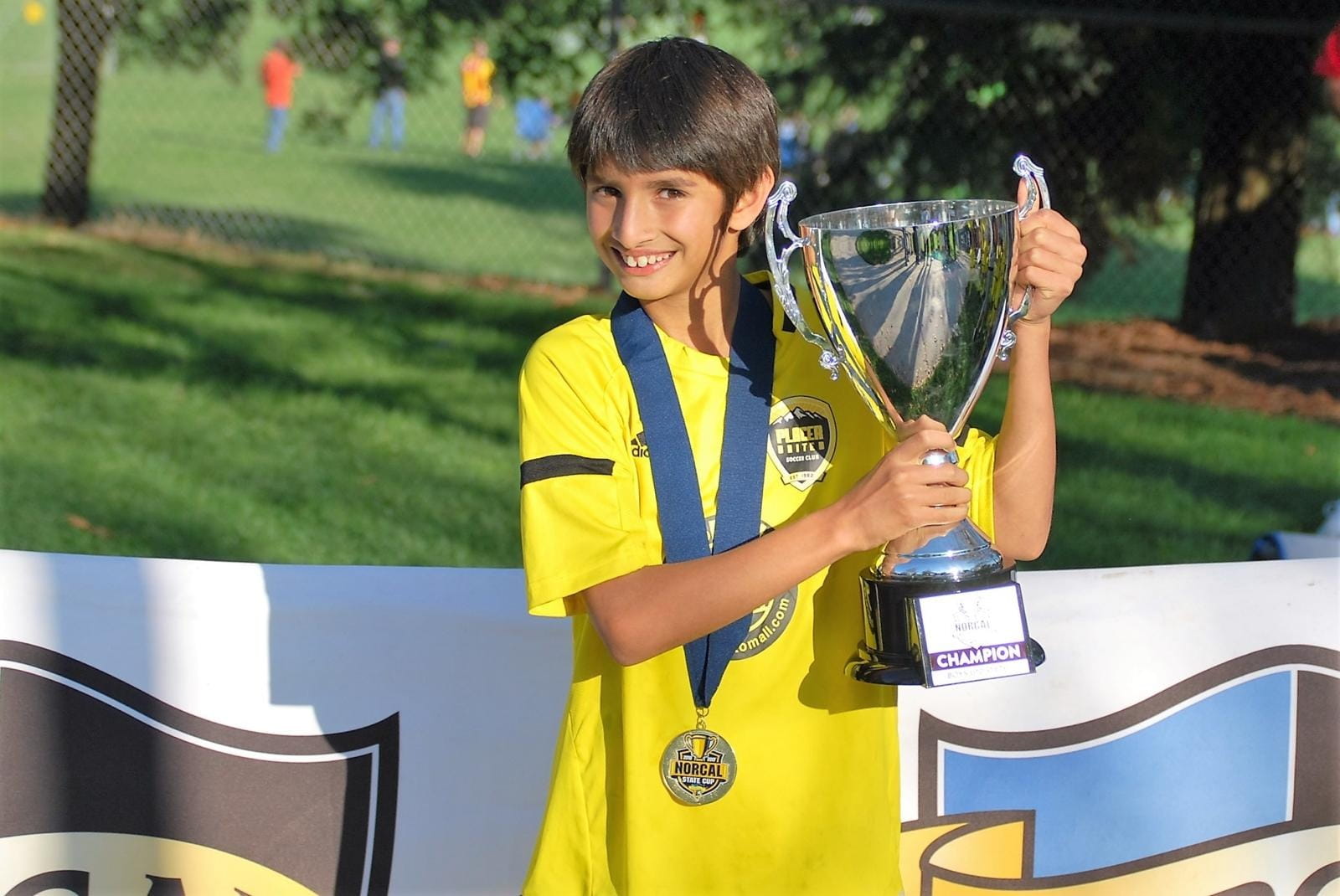
It reads, at a glance, like a scattergun of a career — a young player collecting academies the way other teenagers collect countries on a gap year. Joshi doesn’t experience it that way.
“I think I’ve experienced so much since I was fourteen,” he says. “Living in Spain away from my parents, adapting to a different language, a different culture and a different style of football taught me a lot. Those experiences helped me mature much earlier. They also made me far more adaptable.”
It was, in its way, the training ground for everything that came next — including a decision, at nineteen, to skip the pathway most American teenagers who haven’t turned professional by seventeen or eighteen are expected to take. “Generally, in the United States, if a player hasn’t turned professional by that age, the usual pathway is to go to college and play NCAA football,” he explains. It wasn’t a route he or his family were ever fully convinced was right for him. He’d already proven, twice over, that he could leave home and adapt. So, when the chance arrived, out of nowhere, to play the Durand Cup for a debutant club built almost from scratch in Odisha, he says simply: “Once it came, it was actually a fairly quick decision for us.”
Every Summer, Kolkata
None of that quite explains why a teenager who grew up dreaming in English feels as at home in Kolkata as he does. For that, you have to go back a generation.
Joshi’s mother, Nupur — Nupur Ghosh, before she married — was born and raised in Kolkata. So was his father, Ajay, though the Joshi family traces further back to Varanasi. Both parents grew up fluent in English, Bengali and Hindi. Both left Kolkata after they married, first for England, then for the United States, where their son was eventually born. In outline, it’s an unremarkable story, the kind repeated in a thousand households of a certain Indian professional generation.
What isn’t unremarkable is how deliberately the family kept the thread from fraying. Every year, without fail, young Veer flew to Kolkata the moment school let out and stayed for two and a half, sometimes three months, returning to Sacramento just days before term resumed. It split his childhood cleanly into an American school year and an Indian summer, in a way that left its mark more thoroughly than any single visit could have. Once, on one of those long summers, he even trained for a few weeks at a local football academy in the city — a small, mostly forgotten preview of a chapter that would take another decade to properly begin.
“I’ve always felt extremely connected to India,” he says. He listens to Bollywood soundtracks before matches. He is, by his own admission, more fluent in Bengali than Hindi, simply because Kolkata is where he has always spent his time. There is, he says, a real possibility his family will eventually move back — serious enough that it functions as its own quiet proof of how little his connection to India needs defending. “For us even to consider something like that, we obviously have to feel strongly connected to our roots.”
One thing has always eluded him, though. Durga Puja — the ten days each autumn when Kolkata rebuilds itself as a city of pandals and processions, which his mother has wanted him to experience in person for as long as he can remember — has never once lined up with his football calendar. In America, in Spain, in England, the festival always fell right as a new season began, and the season always won. His family calls him every year from inside it, sending photographs of structures so elaborate that his American friends refuse to believe they’re temporary.
“They ask me, ‘You’re telling me they built something this beautiful only to take it down afterwards?'” Joshi says, laughing. “And I tell them: yes. Then they’ll build completely new ones again next year.
This year, for the first time he can remember, the football calendar and the festival calendar might actually align. He talks about the possibility with something closer to disbelief than excitement, as though he doesn’t quite trust it to happen until it does.
It is against this backdrop, a young man who speaks Bengali, disappears into Kolkata every summer of his childhood, and might one day move his whole life there, that the more complicated part of his story has to be understood.
 Two Documents
Here is what an Overseas Citizen of India card actually gives someone in Joshi’s position: lifelong visa-free travel, the right to live and work in the country indefinitely, almost every practical privilege of citizenship except the vote.
What it does not give him is a passport that says India. Under FIFA’s eligibility rules, representing a country’s senior national team requires holding that country’s actual passport, not a card that approximates it, and India does not recognise dual citizenship at all. An OCI card, however deep the roots behind it, stops just short of the one document that would matter most on a football pitch. This is the terrain Indian football has been circling for much of the past year, as a growing diaspora of young, foreign-trained players of Indian origin has become harder to ignore. There is precedent for the gap being closed: Ryan Williams, born in Australia, became eligible for India only after formally surrendering his Australian passport. The federation has signalled, in recent months, that it is exploring a more structured pathway for players in Joshi’s position. Nothing has been decided.
Ask Joshi how he feels about it, and the answer that comes back is notably unhurried.
“Growing up, I’d always known that representing the Indian national team required an Indian passport,” he says. “Since I grew up in America and hold a US passport, I’d always believed there was very little chance of that ever becoming an option for me.” It’s a sentence worth pausing on: a teenager who simply filed the idea away, early, as belonging to a different life. Not a grievance. Just a fact he grew up with.
That framing hasn’t much changed now that the conversation around him has grown louder. “Because I’d always believed I wouldn’t be eligible, I’d never really thought about playing for the Indian national team,” he says. “Even now, I still don’t think about it too much.” Any decision about actually surrendering his American passport, he adds, wouldn’t be his to make alone. It would involve the same family who talked him through visualisation and free-kick technique the night before Sunday’s match. “They’d understand all the implications better than I do.”
What he will say, plainly, is that the door being open even a crack would mean something. “If OCI players are eventually allowed and that makes me eligible, then of course I’d be incredibly grateful if I were ever selected to represent India.” Beyond that, he doesn’t reach. “Those decisions aren’t within my control. I’m sure the federation will make whatever decision they believe is right.”
On the pitch, in the meantime, the categories mean less to him than they might to a television panel. He arrived at Samaleswari Sporting as a foreign signing and talks about it that way, without complaint. “Before the match and during the match, I don’t spend time thinking about whether people see me as a domestic player, an OCI player or a foreigner,” he says. “I’m just thankful that Samaleswari Sporting has given me the opportunity to play.”
Nor, when pushed, does he recognise the particular pressure that some diaspora players describe: the sense of having to perform an identity, to prove an Indianness that players raised here never have to justify. “Personally, I don’t feel that pressure,” he says. “I’ve never really felt like an outsider. The people around me have always treated me like one of their own.”
Whatever the federation eventually decides, that seems, for now, to be enough for him.
The Days Before Sunday
Sunday wasn’t Joshi’s first taste of this Durand Cup. Days earlier, he’d made his professional debut off the bench, playing roughly forty minutes and looking lively enough that his family, watching from afar, told him he’d created some dangerous moments, while also reminding him, gently, that they knew he had more in him.
He carried that into the build-up differently. Where his debut had been about simply arriving, Sunday became about visualisation, a word he returns to more than once. He spent the days beforehand picturing, specifically, the ball going into the net, something he hadn’t done with the same intensity before. His sister, his mother, his father, his brother-in-law, all leaned into it with him, telling him, in one form or another, to believe it before it happened.
“Believe you’re going to score,” they told him. “Say it out loud. Manifest it.”
His sister put it more starkly than anyone. “If you don’t believe, it won’t happen,” she said. “You have to believe first.”
His father’s advice was quieter, and about something else entirely: the danger of being swallowed by the occasion. “During the warm-up, soak it all in,” he told his son. “Once the game starts, focus only on football.” It’s easy to see why that mattered. Salt Lake Stadium is not a stage most nineteen-year-olds walk onto lightly, and Mohammedan Sporting are not opponents most debutant clubs are supposed to trouble. Joshi’s mother reminded him of something else before kick-off, a fact so obvious it barely needed saying, and yet clearly needed saying anyway: he had been playing football since he was four, in hundreds of matches, on stages smaller than this one and stages just as big. “You’ve played hundreds of matches before,” she told him. “This is still football. It’s you and ten teammates against another team.”
He isn’t, by his own description, a particularly superstitious player, though he does have something close to a ritual. Before matches, he listens to music, a mix of Hindi and English, mostly Hindi, starting calmer with singers like Javed Ali and Mohit Chauhan before building toward something with more urgency. The last song before he walks out is always the same: “Rise of Sultan,” from the film Sultan.
On the bench that evening, waiting for his number to be called, he wasn’t watching the match the way the crowd around him was. “I spend most of my time analysing the opposition,” he says of his usual approach from the sideline, working out where the spaces are, what his role will be if the coach sends him on, which areas he can occupy to receive the ball. “I’m definitely watching the match more like an analyst than a fan.”
When the moment finally came to stand over that free-kick at 2-2, his mind, by his own account, was emptier than the build-up might suggest. Not fear of missing. Not the weight of the equaliser he was about to erase.
“I wasn’t thinking, ‘I have to score,’ or ‘if I miss this,'” he says. “I simply focused on striking the ball cleanly.”
He struck it cleanly. The rest, by his own account, is the part where time stopped.
 A Common Language
If there’s one thing about Indian football that has genuinely surprised Joshi, it isn’t the profile of it all, though walking into Salt Lake Stadium and finding television cameras and a full media pack waiting was, he admits, its own kind of surreal, his first real taste of a proper professional environment. It’s something quieter, discovered in the dressing room rather than on the pitch.
“When you join a team where almost everyone comes from the same country, you realise just how diverse India really is,” he says. His Samaleswari teammates come from the country’s east, west, north and south, carrying languages that don’t always overlap, players who don’t speak English, players who don’t speak Bengali, with nothing in common until the ball is rolled toward their feet. “It doesn’t matter where you’re from, what language you speak or how you were brought up,” he says. “Football becomes the common language.”
He’d known, in the abstract, how much India loved this game. From Sacramento, he remembers watching clips of Indian fans turning out by the thousand for Argentina and Brazil during World Cups their own country wasn’t part of, a passion he admired long before he understood it from the inside. Now he has stood inside it. It’s the same lesson his Kolkata summers taught him about language and belonging, just relearned on a training pitch: the categories that seem so important from the outside tend to matter less once you’re actually in the room.
No Agent, No Plan
What happens after this Durand Cup, Joshi genuinely does not know, and he isn’t performing the uncertainty for effect. He has no agent. Every decision about his future, he says plainly, will be made “together with my family,” the same family that talked him through visualisation and free-kick technique the week before he became a headline. For now, his focus doesn’t extend past Samaleswari Sporting’s remaining fixtures and the group’s slim, still-alive hopes of qualifying for the knockouts.
It’s a fitting place to leave him: a player whose entire career has been a series of unplanned next chapters, Placer County to Sacramento, Sacramento to Madrid, Madrid to Southampton, Southampton back to Sacramento, and now Sacramento to a club built out of a coaching camp in Odisha that most of India couldn’t have located on a map eighteen months ago, still refusing to write the next one before it happens.
Ask him, at the end of half an hour of conversation, if there’s anything he wishes people asked him and never do, and he laughs, genuinely stuck. His parents, he admits, are forever telling him to get to the point, that he gives five different answers to every question because he never seems to stop talking. Eventually, though, something comes to him.
His favourite singer, he says, the best in the world in his own entirely unbiased opinion, is Swaroop Khan, a Rajasthani folk and classical vocalist most people outside that world have never heard of. He brings it up often enough that he’s used to the response by now.
“Sorry… Shah Rukh Khan?” people ask.
“No,” he tells them, laughing. “Swaroop Khan.”
It happens almost every time, he says. It’s the whole conversation in miniature: a name people mishear because it doesn’t fit the shape they were expecting, said patiently again until it lands correctly. Veer Arjun Joshi has spent a fair amount of his nineteen years doing exactly that. And on a Sunday evening at Salt Lake Stadium, for nine unforgettable minutes at the end of a football match, it landed perfectly.
