Rooted in Kolkata, Reaching Five States: The Durand Cup’s Modern Expansion
East Bengal win record-equalling 17th Durand Cup with thumping victory over Mohun Bagan
Midul Doley and the making of a Durand Cup story nobody saw coming
Eleven men & A Village fairy tale: Chesterpoul Lyngdoh and the rise of Nongkseh on the Durand Cup stage
The fear was gone – That was the moment Birendra Thapa knew Shillong Lajong had changed
Mohun Bagan prevail on penalties over defending champions NorthEast United to set up Kolkata Derby final
Lalrinliana Hnamte slipped into the Durand Cup quietly – Then made sure everyone noticed
East Bengal FC edge SC Delhi on penalties to reach 135th IndianOil Durand Cup final
A Stage to Shine: Emerging Talents finds their moment at the 135th IndianOil Durand Cup
A mother’s stick, A Captain’s armband: Kenstar Kharshong’s Durand Cup Odyssey
The long way home: Halicharan Narzary’s return to Bodoland
In the annals of Indian sport, few tournaments possess the history and prestige of the Durand Cup. Established in 1888, it has witnessed the evolution of football in the country across more than a century, surviving wars, political change and the transformation of the domestic game itself. Through every era, however, the tournament has remained steadfast in its commitment to excellence, preserving a legacy that has made it not only Asia’s oldest football competition but also the third oldest in the world.
Yet, even institutions built on tradition must evolve.
The year 2019 marked one of the most significant turning points in the tournament’s modern history. After being staged in Delhi for more than seven decades, the Durand Cup found a new home in Kolkata under the stewardship of the Indian Army’s Eastern Command. The move represented far more than a change of venue. It was the beginning of a carefully envisioned revival, one that sought to reconnect the tournament with India’s football heartland while laying the foundations for a broader ambition: to take elite football closer to communities where the sport has long been woven into the social and cultural fabric.
That ambition has steadily transformed the Durand Cup over the past seven years. What began as a Kolkata-centred revival has evolved into one of the country’s most expansive football competitions, bringing together clubs from across the football pyramid while extending its reach well beyond a single host city. Each successive edition has carried the tournament into new footballing regions, strengthening local ecosystems, engaging fresh audiences and reaffirming its place as the traditional curtain-raiser to India’s domestic football season.
As the 135th IndianOil Durand Cup prepares to unfold across five states—West Bengal, Assam, Meghalaya, Manipur and Jharkhand—the tournament stands as a testament to how a 138-year-old institution can embrace change without compromising its heritage. From the packed galleries of Kolkata to emerging football centres across eastern and north-eastern India, the Durand Cup’s journey since 2019 is not merely one of geographical expansion, but of vision, collaboration and a renewed commitment to growing the beautiful game.
A New Home, A Renewed Vision
For more than seventy years, the Durand Cup had been synonymous with Delhi. While it continued to command respect as one of the country’s most storied sporting institutions, Indian football itself was changing. New professional clubs were emerging, regional football cultures were flourishing, and supporters were engaging with the game in ways that demanded a broader, more inclusive approach. The challenge was no longer simply to preserve the Durand Cup’s illustrious past—it was to ensure that its future remained equally significant.
It was in this context that the Indian Army’s Eastern Command assumed stewardship of the tournament in 2019, ushering in a defining new chapter in its history. Recognising both the tournament’s immense legacy and its untapped potential, the Army envisioned the Durand Cup not merely as an annual competition, but as a platform to strengthen Indian football, celebrate military tradition and connect with communities through sport. Working in close partnership with the Government of West Bengal, the All-India Football Federation and the Indian Football Association, the tournament was relocated to Kolkata—the city whose football heritage, passionate supporters and iconic clubs made it the ideal setting for the next phase of its evolution.
The decision quickly proved transformative. Kolkata embraced the Durand Cup with characteristic enthusiasm, restoring the atmosphere and prominence befitting one of world football’s oldest tournaments. Yet, even as the city reaffirmed its status as the competition’s spiritual home, the organisers were already looking beyond its boundaries. The vision was never to confine the tournament to a single destination. Instead, Kolkata would become the launchpad for a larger mission—to carry the Durand Cup into football-loving regions across eastern and north-eastern India, creating opportunities for new audiences to experience elite competition while strengthening the game’s grassroots ecosystem.
In many ways, the success of the 2019 edition laid the foundation for everything that followed. It demonstrated that the Durand Cup could honour its extraordinary past while adapting to the needs of modern Indian football. More importantly, it established a blueprint for sustainable growth—one driven by the Indian Army’s enduring commitment to the tournament and a shared belief that football’s oldest competition could also become one of its most forward-looking.
From One City to Many: A Vision Takes Shape
If Kolkata represented the beginning of the Durand Cup’s modern revival, the years that followed demonstrated that the relocation was never intended to be an end in itself. The Indian Army’s vision extended far beyond restoring the tournament’s stature in one city. The objective was to build a competition that reflected the changing landscape of Indian football—one that celebrated regional football cultures, inspired young talent and brought top-level football closer to supporters across eastern and north-eastern India.
The first step came in 2022, when the Durand Cup expanded beyond Kolkata for the first time since its relocation. Guwahati in Assam and Imphal in Manipur were added as host cities, transforming the tournament into a multi-state event. It was a landmark moment in the competition’s history. Both states have long been recognised as important contributors to Indian football—Assam with its growing football infrastructure and enthusiastic fan base, and Manipur as one of the country’s richest nurseries of footballing talent. By taking matches to these football-loving regions, the tournament embraced communities that had consistently fuelled the sport’s growth, allowing local supporters to witness elite domestic football on home soil.
The momentum continued a year later with the inclusion of Kokrajhar in Assam. While the town had rarely featured on the national sporting map, its selection reflected the organisers’ willingness to look beyond established metropolitan centres. It reinforced the Durand Cup’s commitment to taking the game to newer audiences, ensuring that the tournament’s growth was measured not simply by distance travelled, but by the communities it reached. For local football enthusiasts, Kokrajhar’s emergence as a host city represented an opportunity to become part of the story of one of the world’s oldest football competitions.
The tournament’s footprint widened further in the years that followed. Shillong, renowned for its vibrant football culture and deep-rooted community support for the game, brought another distinctive football identity into the Durand Cup family. Jamshedpur, with its modern football infrastructure and strong professional ecosystem, added another important dimension to the competition’s expansion. Together, these venues reflected the tournament’s evolving philosophy—one that sought to celebrate the diversity of Indian football by embracing regions where the sport occupies a special place in everyday life.
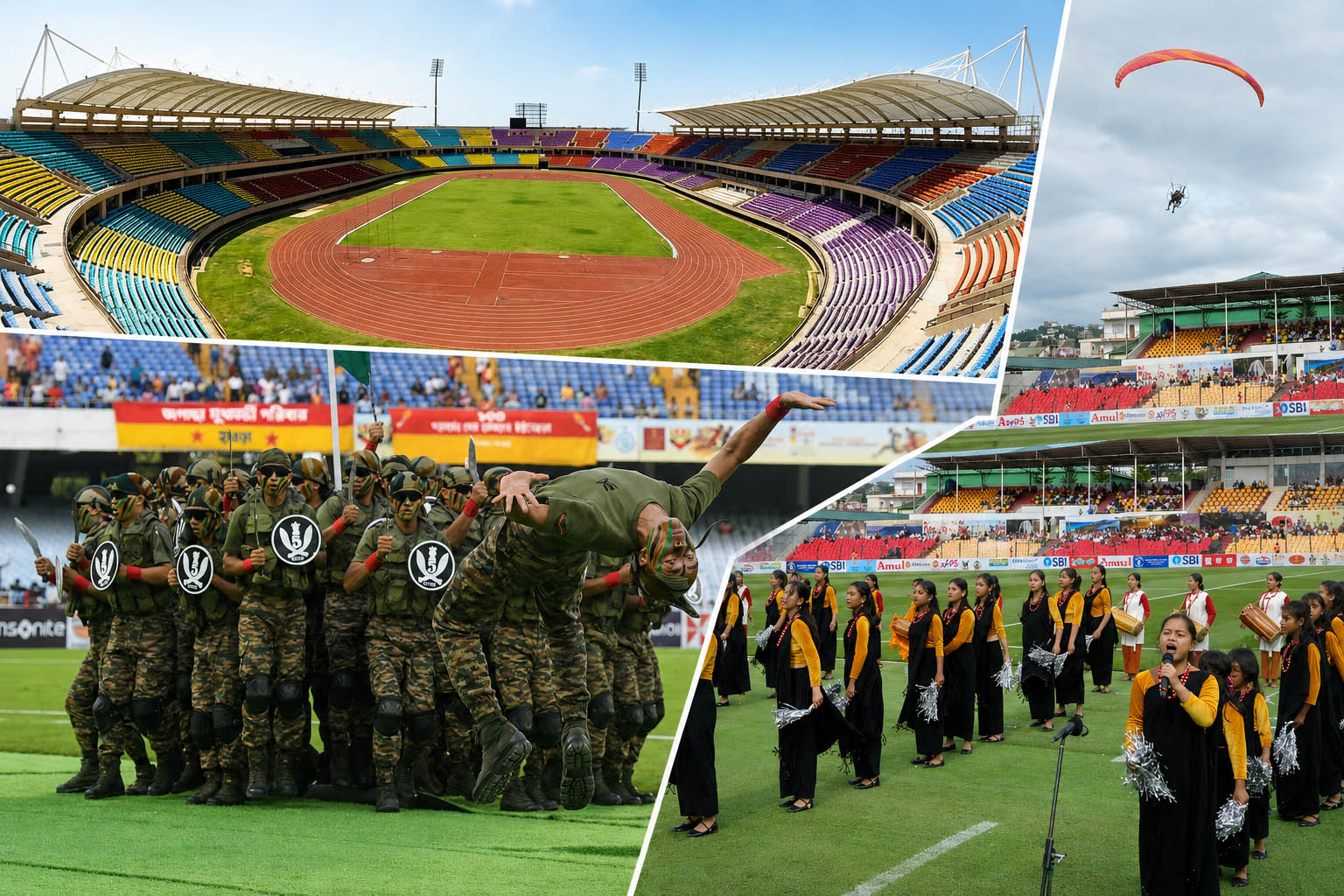
The journey enters another significant chapter in 2026 with the inclusion of Ranchi, taking the Durand Cup to Jharkhand for the first time and extending its footprint across five states. While Kolkata remains the tournament’s spiritual home, the competition today belongs to a much wider football fraternity. From the historic stadiums of West Bengal to the passionate football communities of Assam, Manipur, Meghalaya and now Jharkhand, the Durand Cup has steadily evolved into a tournament that travels to its supporters rather than expecting supporters to come to it.
What makes this expansion particularly remarkable is that it has never come at the expense of the tournament’s identity. Every new host has added its own flavour to the competition while remaining connected to the traditions that have defined the Durand Cup for well over a century. Under the stewardship of the Indian Army, the tournament has demonstrated that preserving heritage and embracing innovation are not competing ideas—they are complementary ones. Each new venue has strengthened the competition’s reach while reinforcing its enduring purpose: to unite football communities, honour sporting excellence and carry forward a legacy that continues to evolve with every passing edition.
Growing Beyond Geography
The Durand Cup’s expansion since 2019 is often illustrated by a map. Kolkata gave way to Guwahati and Imphal, then Kokrajhar, Shillong and Ranchi, taking the tournament across five states. Yet, its most profound transformation cannot be measured in kilometres travelled. It is reflected in the confidence that Indian football has placed in the competition itself.
The clearest evidence lies on the pitch. When the tournament returned to Kolkata in 2019, it featured a 16-team field. By 2022, participation had grown to 20 teams before expanding further to a record 24 clubs from 2023 onwards. More importantly, the quality of the field evolved alongside its size. The Durand Cup today is the only domestic competition that brings together Indian Super League clubs, I-League teams, the Services, and overseas participants under one banner. That unique blend has ensured that every edition offers compelling contests between established champions, ambitious challengers and the Armed Forces teams that remain central to the tournament’s identity.
Equally significant has been the changing mindset of the clubs. In its early years after the move to Kolkata, the Durand Cup was still viewed by some as an opportunity to build match fitness ahead of the league campaign. That perception has shifted considerably. Recent editions have witnessed leading clubs such as Mohun Bagan Super Giant, East Bengal FC, Bengaluru FC, Mumbai City FC, NorthEast United FC and FC Goa fielding near full-strength squads, with marquee foreign recruits and senior Indian internationals featuring prominently from the opening weeks of the season. Coaches increasingly value the tournament not merely for preparation but for the opportunity to compete for the first silverware of the campaign. The intensity of recent knockout fixtures and finals has reflected that change in outlook.
The tournament has also strengthened its international character. Since 2019, clubs and military teams from neighbouring countries have returned to the Durand Cup, bringing different tactical approaches and footballing cultures to the competition. Army Red of Nepal, Tribhuvan Army FC, Bangladesh Army Football Team and other overseas participants have added a distinctive dimension that few domestic tournaments in India can offer. Their presence has reinforced the Durand Cup’s long-standing role as a bridge between military tradition and international sporting camaraderie while providing Indian clubs with valuable exposure to varied styles of play.
Away from the field, the tournament has undergone an equally significant evolution. A defining milestone came in 2023 when Sony Sports Network secured the exclusive broadcast rights, ensuring every match reached audiences across television and digital platforms through Sony LIV. The agreement expanded the tournament’s visibility far beyond the host venues, with broadcasts reaching viewers across the Indian subcontinent. For a competition once followed primarily by those inside the stadiums, it marked a decisive step into the modern sporting landscape.
That wider reach has been complemented by a deliberate effort to deepen fan engagement. The Durand Cup’s Trophy Tour, introduced in its current form after the tournament’s relocation, has evolved into one of its most recognisable traditions. Travelling through schools, military establishments, universities, iconic landmarks and football academies across the country, the three historic trophies have become ambassadors for the tournament long before the opening whistle. Combined with an increasingly sophisticated digital strategy featuring behind-the-scenes storytelling, player features and interactive fan content, the initiative has helped transform the Durand Cup from a month-long competition into a sustained football celebration.
Commercially, too, the tournament’s resurgence has been unmistakable. The title partnership with IndianOil has provided long-term stability and strengthened the competition’s brand identity, while enhanced production standards, expanded broadcast coverage and growing sponsor interest reflect increasing confidence in the Durand Cup as a national sporting property. Heritage alone does not attract sustained investment. It must be matched by relevance, reach and the ability to engage contemporary audiences. Over the past seven years, the tournament has demonstrated all three.
Perhaps the greatest measure of the Durand Cup’s growth, however, is something that cannot be captured in statistics. It is visible in the expectations that now surround every edition. Clubs arrive expecting to compete seriously. Players view the tournament as an opportunity to announce themselves on one of Indian football’s biggest stages. Supporters anticipate high-quality football from the opening match, while broadcasters and commercial partners recognise the value of a competition that successfully combines heritage with contemporary appeal.
That transformation has not occurred by chance. It has been the result of a clear and sustained vision—one that has expanded the Durand Cup not only across geography but also across influence. Since 2019, the tournament has become bigger in every measurable sense. More importantly, it has become stronger, proving that a competition founded in 1888 can continue to evolve while remaining true to the traditions that have defined it for more than a century.
